THE MYSTERIOUS CONSTRUCTION OF SOLTANLI VILLAGE
27.11.2026 / Hungary says the millions allocated to the village have been used, but...
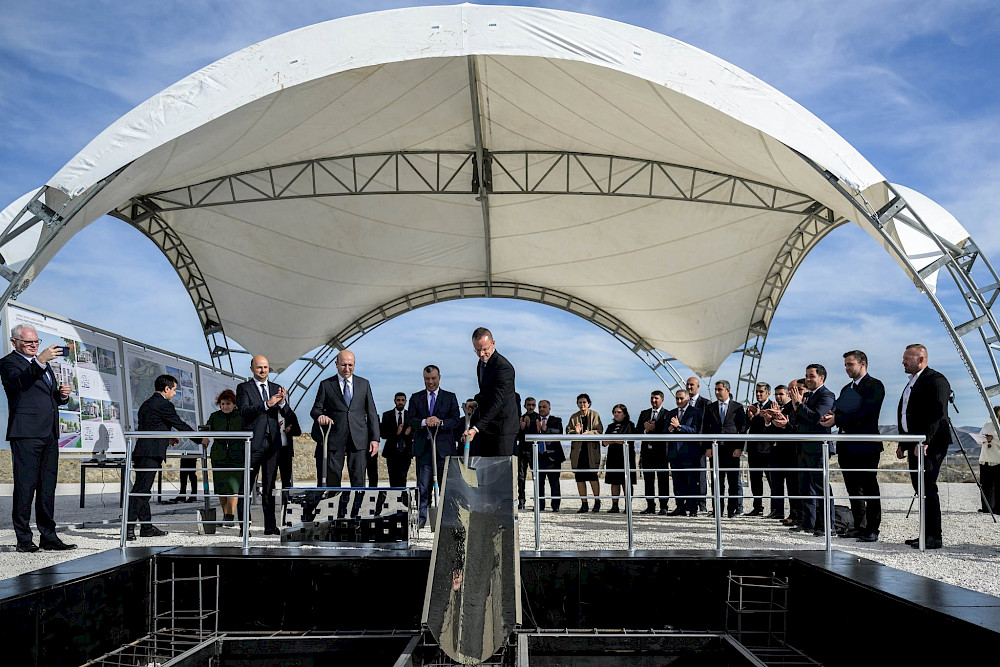
Former Hungarian Foreign Minister Péter Szijjártó lays the foundation stone of Soltanli village, 23 November 2023.
The first phase of Soltanli village in Jabrayil district was inaugurated on November 6, 2026.[1] According to official information, the village covered an area of 108.5 hectares in the first phase. A total of 420 individual houses, an administrative building, a kindergarten, a medical centre and a multifunctional building were constructed in the area. If we compare this list with that of Jahangirbeyli village, which was inaugurated on the same day and has a smaller population, we see that Soltanli has no school building. The village with 242 individual houses has a school, but the village with 420 individual houses does not. The distance from the village to the district centre, the city of Jabrayil, is 14 km, meaning that travelling from there to attend school in the district centre is like living in Masazir and studying in Baku. How will this be organised? Why was no school built during the first phase of Soltanli village?
The Hungarian companies rebuilding Soltanli
In the summer of 2023, Azerbaijan and Hungary reached an agreement to supply 100 million cubic metres of gas and store 50 million cubic metres of Azerbaijani gas in underground gas storage facilities in Hungary. On September 12 of that year, at a joint press conference in Budapest with Azerbaijan’s then Minister of Economy Mikayil Jabbarov, Hungarian Minister of Foreign Affairs and Trade Péter Szijjártó announced that Soltanli would be rebuilt by a consortium of Hungary’s largest construction companies.[2] Two months later, on November 24, a groundbreaking ceremony was held in Soltanli village in Jabrayil district. The ceremony was attended by Hungarian Minister of Foreign Affairs and Trade Péter Szijjártó, Minister of Labour and Social Protection of the Population Sahil Babayev, Chairman of the State Committee for Urban Planning and Architecture Anar Guliyev, Special Representative of the President of the Republic of Azerbaijan in the Jabrayil, Gubadli and Zangilan districts of the East Zangezur economic region Vahid Hajiyev, and residents of Soltanli village.[3] According to official information, the master plan for Soltanli village was prepared by the AzerMemarLayihe State Main Design Institute and Hungary’s KÉSZ Group, which operates in the construction and design sectors, on behalf of the State Committee for Urban Planning and Architecture of the Republic of Azerbaijan. In its own statement, however, KÉSZ Group said that another Hungarian company, bim.Group.[4]
 Both KÉSZ Group and bim.Group are ordinary Hungarian companies. The KÉSZ group of companies was founded in 1982 as a family business and is owned by an entrepreneur named Mihály Varga.[5] The company is not often seen in local government tenders and mainly participates in private and foreign projects. bim.Group is a relatively small planning and design company. It was previously the architectural office of KÉSZ Group itself and has operated as an independent company within the group[6] only since 2017.[7]
The Hungarian company’s Azerbaijani division had not been reporting
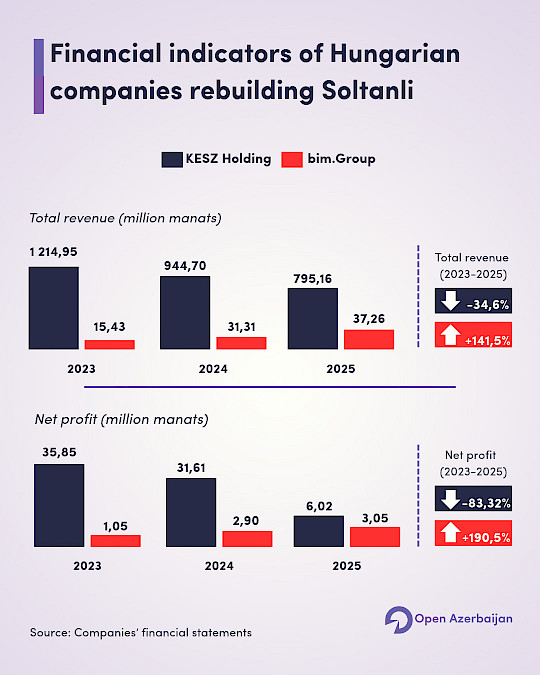
Looking at the financial statements, we can see that KÉSZ Group’s turnover has fallen by 34% over the past three years. The company’s management attributes this to the pre-election uncertainty that has persisted in Hungary in recent years.[8] According to them, private-sector investment was partially suspended before the election, as investors waited for the election. Since the company depends mainly on private investment, its revenue declined.
What stands out is that the official report contains no information about KÉSZ Group’s Azerbaijani division. The financial report states that “the division did not provide information for the consolidated report.” Moreover, this information was provided neither in 2024 nor in 2025 (neither KÉSZ Group’s consolidated report nor its divisions' reports contain financial information about the company in Azerbaijan; only registration details are included). In its report to shareholders, the company’s management briefly writes, “A KÉSZ Csoport alacsony kockázatú szereplőként megkezdte azeri integrációját,” meaning: “KÉSZ Group has begun its integration into Azerbaijan as a low-risk player.”
But bim.Group does not conceal that its revenues have also increased thanks to Azerbaijan
bim.Group’s financial statements show that its revenues have increased significantly.[9] The company’s earnings doubled in 2024, and this trend continued in 2025. The company earned 420,000 manats from design work that began in Azerbaijan in 2023. Another design project brought the company an additional 6.3 million manats. Thus, 10% of the 68 million in revenue earned by bim.Group over two years officially came from Azerbaijani projects. Moreover, the company may also have participated as a subcontractor in KÉSZ Group’s other projects in Azerbaijan (additional design, supervision, engineering, etc.). This means that more than 10% of the total revenue of 68 million came specifically from Azerbaijan. In any case, bim.Group, the architectural division of KÉSZ Group, has increased its earnings significantly since it began operating in Azerbaijan.
NOTE: In addition to acting as a subcontractor for KÉSZ Group, bim.Group itself outsources many services to others. In its report, it notes that 88% of its revenues were generated through other companies associated with it. In other words, it outsourced the work carried out in Soltanli village to a third party.
Hungary has given Azerbaijan 189 million manats to rebuild Soltanli
Both companies mentioned are merely contractors; the main issue is Hungary’s participation in building the Soltanli school and the village as a whole. Unlike in the Azerbaijani media, Soltanli village has long been in the Hungarian media spotlight. On December 4, 2025, a media outlet called Magyar Hang reported[10], citing the local Open Data portal, that Hungary had paid Azerbaijan 39 billion forints, or approximately 189.1 million manats, for the reconstruction of Soltanli village. This payment consisted of three parts:
1. Support for the design of the Soltanli school – HUF 1,350,679,922 (approximately 6.5 million manats)
2. Construction work as part of the reconstruction of Soltanli – HUF 27,635,760,000 (approximately 134 million manats)
3. Construction of residential buildings as part of the reconstruction of Soltanli – HUF 10,010,069,000 (approximately 48.5 million manats)[11]
NOTE: These figures are approximate and are based on the official annual average exchange rate of the Central Bank of Azerbaijan for 2025. If we convert the amount allocated to support the design of the Soltanli school at that exchange rate, it comes to approximately 6.5 million manats, but bim.Group’s financial report indicates that it received 6.3 million from the state for the design work.
The register cited states that the 39 billion forints were allocated through Hungary Helps Ügynökség Nonprofit Zrt., which operates under Hungary’s Ministry of Foreign Affairs. (This organisation, known for short as Hungary Helps, was established for various humanitarian purposes and operates in many parts of the world, at least by allocating funds and providing support.) The organisation was chosen merely as an intermediary for making the payment to Azerbaijan, since the funds were transferred without being recorded on the agency’s balance sheet.
The design work for the Soltanli school was supposed to be completed in December 2024
According to the official record on the Open Data portal, the design work for the Soltanli school was supposed to be completed by December 31, 2024. bim.Group’s financial report states that 6.3 million manats were received from Hungary Helps and that the work for which this amount was allocated was to be completed by May 28, 2025. In its 2025 report, as noted above, bim.Group recognised the 6.3 million manats as its own revenue and stated that the work had been completed.
In fact, this amount would have been enough not only to carry out the design work but also to build a large school complex. For example, the construction of a school for 360 pupils in Shukurbeyli village in Jabrayil district cost 4.5 million manats.[12]
The reality is that the Hungarian government’s “gift” (Otto Izsó, head of the KÉSZ group of companies, said at the groundbreaking ceremony in Soltanli village that the school was a gift to Azerbaijan[13]) has still not been inaugurated. What has prevented this? How did Soltanli end up being handed over without a school?
Let us look at the chronology
In August 2024, the Hungarian government allocated 6.3 million manats for the school's design. Presumably, the funds have been spent, and construction of the school has begun, since there are no reports in the press, even in the Hungarian media, claiming otherwise.
On June 3, 2025, SOCAR and MOL Group signed a Heads of Agreement for the Shamakhi–Gobustan block.[14] Under the Heads of Agreement, MOL Group was to hold a 65% stake and SOCAR a 35% stake in the project, with the Hungarian company acting as the operator.
On August 15, 2025, the state body, the Restoration, Construction and Management Service in the Jabrayil, Gubadli and Zangilan districts, signed a contract with a consortium of two companies, KÉSZ Group and Construction and Repair Department No. 19 LLC, for the procurement of works in Soltanli village involving individual residential houses, non-residential facilities, internal and external engineering utility systems (water, sewerage, communications network, electricity supply and gas pipelines), roads and pavements (landscaping and improvement works). Information about this contract, worth 114.5 million manats, was published a month later, on September 19.
On September 1, 2025, the Hungarian government allocated 37.64 billion forints, or approximately 182.5 million manats, for construction in Soltanli (information from Hungary’s Open Data portal). However, these funds are being allocated in instalments.
In September 2025, a Letter of Confirmation on the Acceptance of Grant Funds for the project “Reconstruction of residential buildings as part of the construction of Soltanli village in Jabrayil district of the Republic of Azerbaijan” was signed between the Ministry of Economy of the Republic of Azerbaijan and Hungary Helps (as stated in the report of the Azerbaijani Cabinet of Ministers). Under this document, the Hungarian state was to allocate a grant of USD 30 million for the reconstruction work being carried out in Soltanli village in Jabrayil district. Thus, the 48.5 million manats allocated for the construction of residential buildings as part of the reconstruction of Soltanli were received by the Azerbaijani government.
Under a presidential decree signed on September 30, 2025,[15] SOCAR is authorised to prepare and sign an agreement with MOL Vector Ltd on exploration, development and production sharing in parts of the Shamakhi, Gobustan, Absheron, Hajigabul and Agsu districts.
On December 17, 2025, SOCAR and Hungary’s MOL Group sign an exploration and production sharing agreement for Azerbaijan’s Shamakhi–Gobustan area.
On April 12, 2026, parliamentary elections are held in Hungary. The election results bring about a change of government, and the opposition comes to power.
Four months after the signing of the agreement between SOCAR and MOL Group, and four days after the change of government in Hungary, the Azerbaijani Cabinet of Ministers approves the government’s guarantee and obligations under the agreement.[16] After that, all that remains is for the agreement to be ratified by the Milli Majlis. But the matter drags on: 11 months have passed, and there is no news of ratification.
Have relations with Hungary’s new government left Soltanli without a school?
The aforementioned Hungary Helps notes in its report on the results of 2025 that all funds allocated to Azerbaijan have been fully used.[17] Moreover, according to the source, 27 billion forints, or approximately 131 million manats, were allocated not to “construction work as part of the reconstruction of Soltanli,” but specifically to the construction of a “school complex in Soltanli village.” Allocating 131 million manats for the construction of a single school complex is somewhat strange. Perhaps the authors of the report mixed up the names (the same agency spent 285 million forints, or approximately 1.4 million manats, through various other funds under the heading of “aid to Armenians”).
NOTE: Following the change of government, a comprehensive financial audit has been launched at the Hungary Helps agency, which operates under Hungary’s Ministry of Foreign Affairs and finances aid projects in foreign countries. The head of the agency has been replaced, and all contracts concluded and all payments made under the previous government are being reviewed.[18]
Thus, based solely on open sources, we can state that Hungary allocated 189 million manats for the reconstruction of Soltanli village. Part of this was sent in 2024 and part in 2025. We can assume that the final instalment was due to arrive in 2026. The allocation of funds and the oil and gas discussions between the two countries coincide chronologically, but the change of government in Hungary (as well as the uncertainty observed since the beginning of the year) has brought the work to a halt. The Azerbaijani government is not submitting the agreement signed with MOL Group to parliament for ratification, while the Hungarian side is providing no information about the projects announced in Soltanli village.
As a result, no information can be found not only about the second phase of the village, but even about the school included in the first phase.
There is one more point: in 2025, after the period when the grant from the state came in, bim.Group paid 3.7 million manats in dividends. Perhaps the school has been built, and its official inauguration depends on relations with Hungary.
[1] https://azertag.az/xeber/cebrayil_rayonunun_soltanli_kendinin_birinci_merhelesinin_achilisi_olub__yenilenib__video-4498188
[4] https://www.keszgroup.com/en/news/soltanli-cornerstone-laid-another-international-opportunity-kesz-group
[6] https://epiteszforum.hu/egy-altalunk-megirt-segedprogrammal-a-pepecseles-konnyu-mozdulattal-kivalthato--beszelgetes-a-bimgroup-csapataval
[10] https://hang.hu/belfold/kozel-negyvenmilliardot-adhat-a-kormany-egy-azerbajdzsani-falu-ujjaepitesere-183184
[11] https://kif.gov.hu/adatszolgaltatasok/adat?contractingPartyName=Hungary+Helps+%C3%9Cgyn%C3%B6ks%C3%A9g+Nonprofit+Zrt.&contractSubject=Soltanli&visibleKeys=contractingPartyName%2CcontractSubject%2CperformanceLocation%2CprovisionPeriodStart%2CprovisionPeriodEnd&pageSize=25&view=card
[13] https://report.az/infrastruktur/kesz-soltanli-kendinde-tikilecek-mekteb-macaristandan-hediyyedir