MIKAYIL JABBAROV’S “NEW JOBS”
09.11.2025 / Official statistics contradict the minister’s claims about 426,000 new private-sector jobs
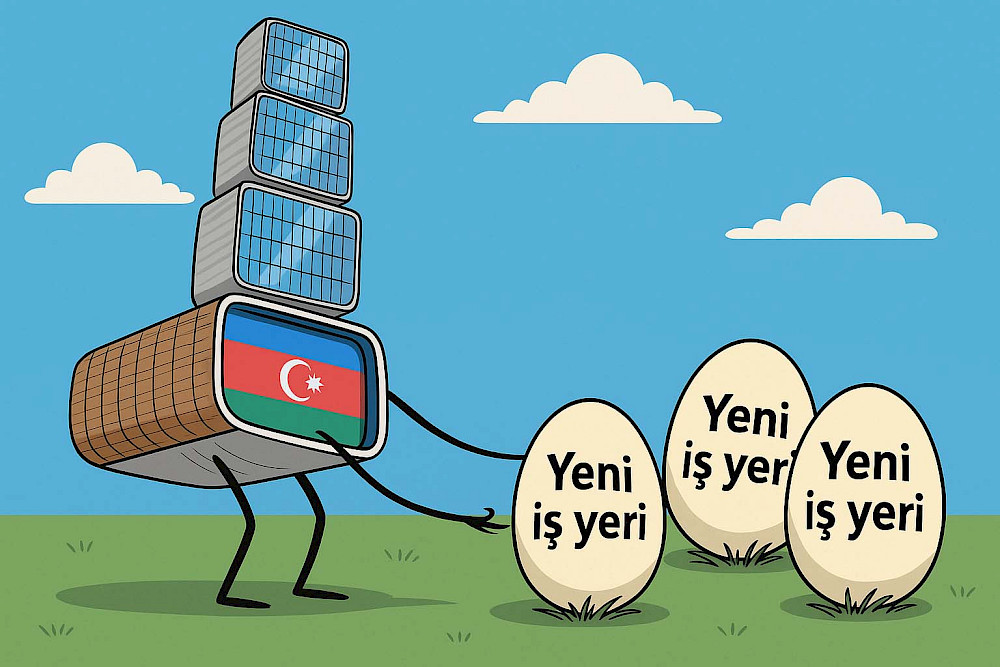
Minister of Economy of Azerbaijan Mikayil Jabbarov stated that over the past five years, the number of labor contracts in the private non-oil sector has increased by 79%. According to him, this means 426,000 new contracts, signifying qualitative changes in the labor market and the leading role of the private sector in economic growth. [1]
But where did Jabbarov get these numbers? The State Statistics Committee (SSC) regularly publishes labour market indicators, including monthly summaries and detailed annual reports. According to the SSC, by the end of 2024, the number of employees working for wages in Azerbaijan was 1,780.8 thousand people. Of these, 884.3 thousand were employed in the public sector, and 896 thousand in the private sector.
If we take the minister’s statement at face value — that the number of private-sector employees increased by 426 thousand — then at the end of 2019 there should have been only 484 thousand people working in the non-state sector. However, SSC data show that during that period there were 729.9 thousand employees working under contracts in the private sector. Thus, over five years, the number of salaried private-sector employees increased by only 166.1 thousand, which is 2.6 times less than the minister’s figure.
It is also worth noting that during this period, the number of salaried employees in the public sector decreased by 32.4 thousand. Overall, over the last five years, the total number of employees in the country increased by 133.7 thousand. Yet, considering the growth rate of the labor force, this is a very modest figure. SSC data show that between 2019 and 2024, due to population growth, the labor force increased by 274.4 thousand people. The increase in the number of contracted employees accounts for 48.7% of this labor force growth.
What explains this “growth”?
Let’s look more closely at the nature of this increase. Observations — and even admissions by government officials — indicate that the main part of the rise in formal employment is due to the legalization of the shadow economy, meaning the formal registration of existing workers. This process actually began in the post-devaluation period.
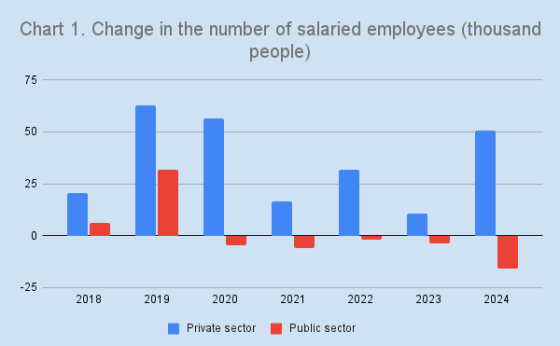
After the devaluations, the highest increase in private-sector employment was recorded in 2019 — about 63 thousand people. Following the pandemic, this pace slowed down, and only in 2024 was a noticeable increase observed again (50.7 thousand people). However, in 2024, the public sector also lost 15.9 thousand jobs.
Statistical data also show that the total number of salaried employees is expected to decline again in 2025. As of early September this year, the number of wage earners stood at 1,764.9 thousand, meaning a decrease of 15.4 thousand employees between January and August. [2]
It should be noted that the last time the number of wage earners decreased was in 2015, the year the manat lost more than half of its value after two devaluations. That year, the number of salaried workers decreased by 15,600.
How does the minister “play” with the numbers?
Mikayil Jabbarov has a habit of manipulating figures when it comes to job creation. In November 2023, during parliamentary discussions on the state budget, he claimed that “over the last 4 years and 9 months, more than 340 thousand new labor contracts have been signed. This means, on average, 75 thousand new jobs per year, including during the pandemic period. For the first time, the share of the private sector exceeded 50%, meaning that the labor market is now dominated by the private sector rather than the state.” [3]
About a month later, at the Azerbaijan–Turkey Investment Forum, Jabbarov stated that “over the past five years, including the pandemic years, 70 thousand new jobs were created annually in Azerbaijan’s non-oil-and-gas sector.” [4]
However, as shown in the data (see Chart 1), in recent years, the increase in the number of labor contracts in the private sector has never reached 70 or 75 thousand per year.
Moreover, contrary to the minister’s claims, neither in 2023 nor in the previous years did private-sector employees account for 50% of total salaried workers. That threshold was reached only in 2024, and even then, mainly because 15.9 thousand jobs were cut in the public sector.
Expected economic stagnation in 2026
Recently, during parliamentary debates on the “State Budget for 2026”, Mikayil Jabbarov slightly “lowered the bar,” announcing that 44 thousand new jobs would be created next year.
This more modest projection likely reflects the reality of the emerging economic slowdown, as the country is already showing signs of another looming crisis. The minister is likely also aware that between January and August 2025, 15,400 jobs were lost across the country.
Official statistics directly contradict Minister Mikayil Jabbarov’s claims about massive job creation in the private sector. The actual increase in salaried private-sector employment is significantly lower than announced, and much of it stems from the formalization of existing informal jobs — not the creation of new ones.
The government had forecast 3.5% GDP growth for 2025, but the actual figure is expected to be only 1%. For 2026, the projection is 2.9%. But the question remains: what could possibly change in the next three months to justify such optimism?
Azerbaijan’s economic performance remains heavily dependent on oil and gas revenues. In January–September 2025, oil production fell by 4.6%, while natural gas output increased by 1.8% — not enough to offset declining revenues. Moreover, falling global oil prices have led to a 4.6% decrease in exports (January–August data).
The projected oil price for next year — $65 per barrel — suggests that national revenues will decline further in 2026. The government plans to cut:
- Public investment by 9%;
- Agriculture spending by 9.3%;
- Housing and utilities by 19.4%;
- Culture, media, and sports by 8.6%.
- Crisis beyond the oil sector
The downturn isn’t limited to the oil industry. Agriculture, which has long been sustained by subsidies, is also stagnating. In January–September 2025, crop production fell by 0.7%, while the number of both large and small livestock continues to decline.
Although non-oil exports increased by 10.3% in nominal terms (January–August), in real terms — adjusted for inflation — they fell by 13.4%..[5]
[1]https://x.com/MikayilJabbarov/status/1820353751175098509
[2]https://stat.gov.az/news/source/doklad_2024-12.pdf
[3]https://report.az/biznes-xeberleri/mikayil-cabbarov-340-min-emek-muqavilesi-baglanilib
[4]https://525.az/news/246737-her-il-qeyri-neft-qaz-sektorunda-70-min-yeni-is-yeri-yaradilir-mikayil-cabbarov
[5]https://stat.gov.az/news/macroeconomy.php?lang=az&page=1